
GREGOR ZUROWSKI
HENRI STÉPHANOU
ALEXANDER GSCHWENDTNER
This article has been first published in: IEEE Annals of the History of Computing ( Volume: 48, Issue: 2, April-June 2026)
Zurowski, Gregor, Henri Stéphanou, and Alexander Gschwendtner. ‘Notes From the HaPoC 8 Conference’. IEEE Annals of the History of Computing 48, no. 2 (2026): 81–84. https://doi.org/10.1109/MAHC.2026.3683569.
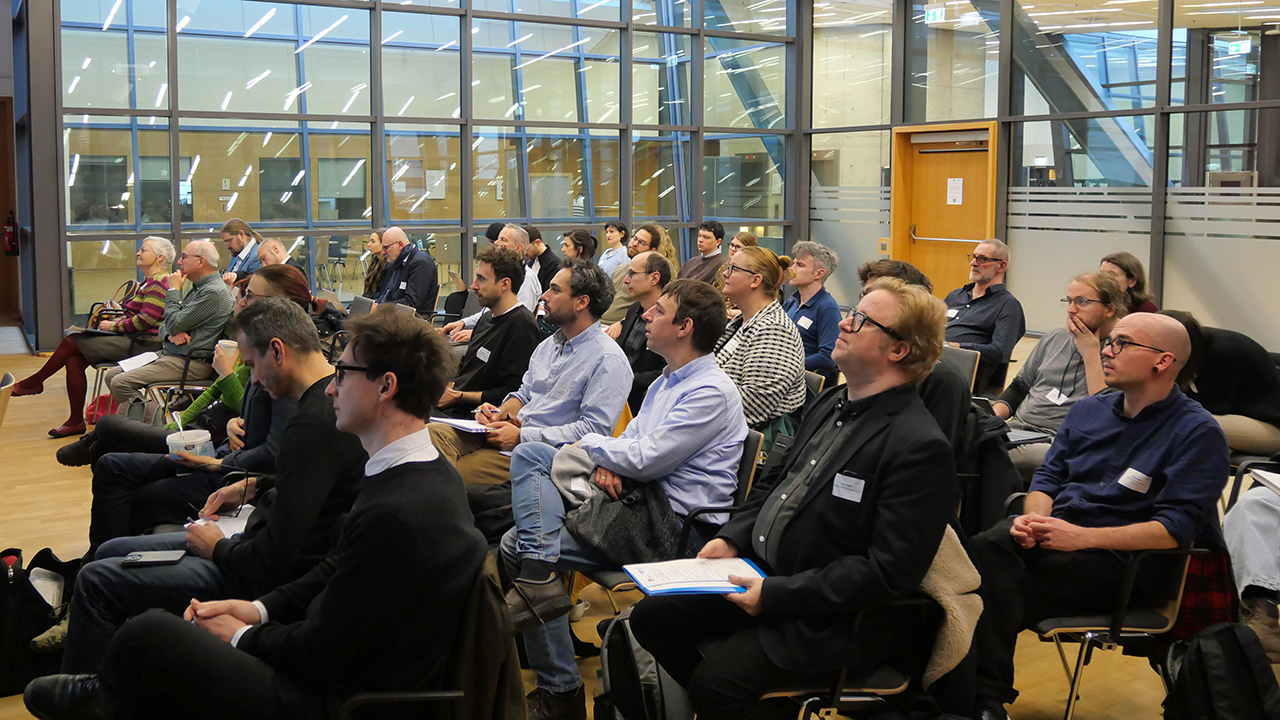
The eighth edition of the History and Philosophy of Computing (HaPoC) conference series took place at RWTH Aachen, Germany, from December 17–19, 2025. The three-day event consisted of five sessions, with presentations grouped around the broad thematic intersection of computing, science, philosophy, and history.
DAY 1
The morning session was opened by Elisabetta Mori (Pompeu Fabra University), presenting her work on Christopher Evans, a British multidisciplinary researcher who helped shape a public understanding of computing in the 1960s-1970s. His book and TV documentary, The Mighty Micro, accurately predicted the impact of the microcomputer revolution. Mori focused on how Evans addressed fears and anxiety about computers in the public debate. Magnus Rust (University of Basel) spoke about MIT’s Project MAC from the early 1960s, explaining how time-sharing systems represented the first wave of democratizing computer use, though they were still limited to a small audience. He explored how this new system received attention beyond technologists, such as from researchers in psychology and the social sciences who were interested in the impact of computers on society.
The startup sounds of Apple and Microsoft operating systems were analyzed by Kate Mancey (Utrecht University). She called these sounds “cybernetic doorbells,” indicating computer readiness, and examined how the different approaches changed the user’s perceptions of computers throughout the decades.
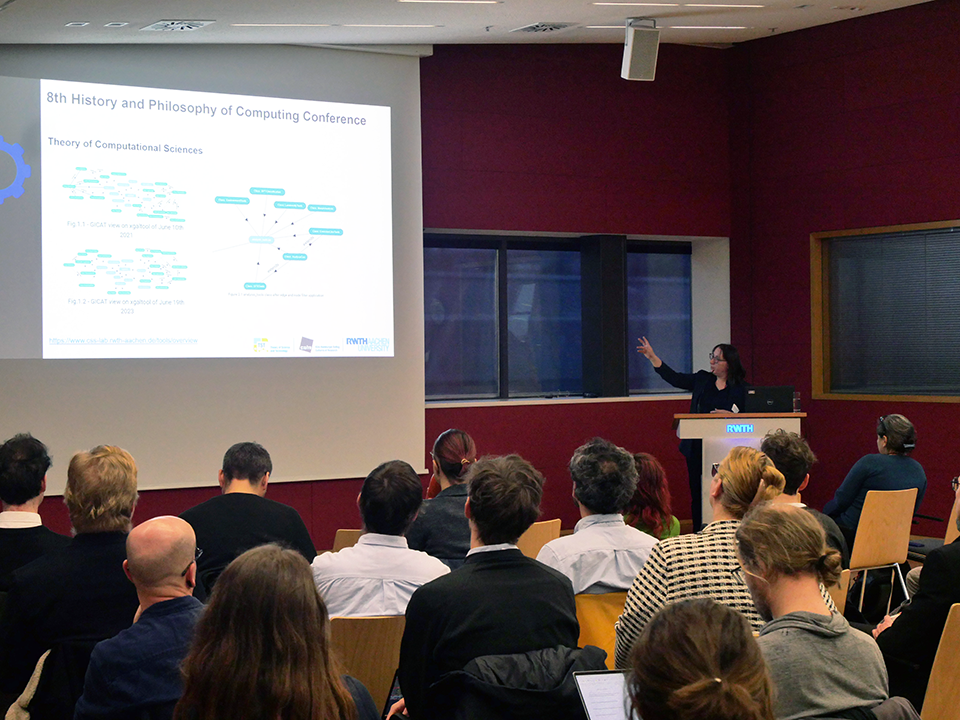
Christina Schinzel (Paderborn University) argued that the concept of backpropagation, a central component of neural networks, is rooted in Freud’s 1895 work on the “psychic apparatus,” where emotional charge is passed backwards between objects. Machine learning researcher Paul Werbos drew on Freud’s work for his research on neural networks in the 1980s-1990s, although his work is not widely known, possibly due to the AI winter that followed in the 1990s. The role of metaphors, analogies, and figurative names, referred to as “illustrative devices,” in programming language semantics in the 1960s-1970s was examined by Troy Astarte (Swansea University). Astarte argued that such devices were used not only to name concepts but also to shape how computer scientists understood abstraction in the early period of computer science.
In the final presentation of the morning, Gábor Képes (Eszterházy Károly Catholic University) examined the 1980s hobby computer scene in communist Hungary, focusing on Hungarian engineer Endre Simonyi, who established a computer club in Budapest modeled after the American Homebrew Computer Club. Because the state emphasized industrial computers and desktop calculators, home computing resources remained scarce, prompting the Hungarian computer scene to clone Western designs and develop DIY kits.
The afternoon session focused on computing in scientific research and began with Lara Marziali (Polytechnic University of Milan), who discussed the role of supercomputers in science and the rise of simulation methods at CINECA, an Italian supercomputing center established in 1969. Supercomputer use peaked in the 1980s and drove wider adoption of simulation and visualization within scientific communities.
Marcus Carrier (TU Berlin) explored the developments in predicting protein structures for drug discovery and the growing adoption of neural networks in chemistry since the 1980s. Despite initial skepticism about the lack of theoretical foundations, the technology’s good results and accuracy helped it establish quickly. These developments led to the 2024 Nobel Prize for Google’s AlphaFold, though its “closed science” model remains controversial.
Paula Muhr (Brand University of Applied Sciences and TU Berlin) described image-reconstruction processes for black hole images from the Event Horizon Telescope. The complex reconstruction process from terabytes of noisy data took years to complete and raised questions about reproducibility, prompting multiple independent reanalyses.
In the session’s final talk, Jérémy Grosman (University of Namur) presented the ant colony optimization algorithm, a probabilistic approach to finding good paths in graphs, inspired by ants’ use of pheromones to identify short paths to food sources. Grosman concluded that metaphors used as cognitive devices have helped engineers implement new algorithms and prompted them to seek analogies in other fields, such as biology.
The day concluded with a keynote by Alexandre Hocquet (University of Lorraine) discussing how the commodification of software in computational chemistry over the decades ultimately led to a closed ecosystem centered around a few corporate players. Despite claims of openness, users have lost agency due to unmodifiable software packages and increasingly restrictive licensing models.
DAY 2
The second day began with a reflexive keynote by Liesbeth De Mol (University of Lille), tracing her journey from initial apprehension of computers, her academic nomadism across disciplines, to eventually developing a deeper interest in computing. This led her to initiate interdisciplinary programs exploring computing from humanistic perspectives, including the HaPoC conference itself and the ANR-funded PROGRAMme project, which investigates the historical and philosophical underpinning of computer programs. The first session featured presentations on the materialities of computing.
Johannes Lenhard (RPTU Kaiserslautern) spoke about the Club of Rome’s 1972 “Limits of Growth” report, which employed computer simulation to predict the limits on economic growth, population, and pollution. Despite early setbacks, mathematical models and computer simulations fostered a culture of prediction in which the future became a scientific subject.
In the next presentation, Krisztián Németh (Budapest University of Technology and Economics) described the restoration project for MESZ I, Hungary’s first electromechanical computer from the late 1950s. Challenges of rebuilding the machine without sufficient documentation ultimately led to pursuing a multi-year reverse-engineering approach, supplemented by creative approaches, such as reconstructing a program by analyzing each frame from a historical 60-second newsreel.
Clément Bonvoisin (Paris Cité University) compared the materialities of analogue and early digital computing instruments through an early US Air Force project in which the RAND Corporation used an analog REACT computer and IBM’s 604 digital calculator. Bonvoisin outlined how the two approaches complemented each other, though analog variants eventually disappeared.
Ulf Hashagen (Deutsches Museum) examined the concept of authenticity through the disrupted history of Zuse’s computing machines. He explored different perceptions of authenticity among researchers and the public, and how Zuse sought to use the museum to elevate his machines and partially rewrite history. Hashagen suggested that commercial interests motivated Zuse’s donations to the museum rather than altruism.
The afternoon session explored conceptual inventions in modern programming languages in their formative years. David Nofre discussed the Backus-Naur form in an economic context, where IBM feared the competition that ALGOL presented to FORTRAN. The “flight to abstraction” was motivated by a project to decipher how to efficiently convert programs between languages. Amelie Mittlmeier (LMU Munich) described the complex dynamics of collaboration in the “design by committee” approach that characterized ALGOL. The frustration expressed by many prominent members of WG 2.1 speaks volumes about the challenges and internal failures it faced, despite its global achievements.
Jad Kadan (Tel Aviv University) focused his presentation on frequent cases of parallel invention, with particular focus on the concept of subroutines, which emerged from the parallel work of the UNIVAC and EDSAC groups. Beyond the rapid circulation of ideas in the nascent discipline, there were common problems and a common approach to problem-solving based on continuous improvement and compositionality. Simone Martini (University of Bologna) analyzed the emergence of the exception-handling construct, which survived the structured programming movement despite the ambiguities surrounding its intent and design. It required lengthy discussions to convince programming language designers of its usefulness in “interleaving actions belonging to different levels of abstraction.”
Finally, Mathilde Fichen (CNAM) recounted the little-known story of the adoption and promotion of Prolog in the 1980s by a CAD community in Edinburgh. This was driven by the conceptual appeal of constraint programming, which was seen as embodying the very logic of architectural design.
This session was closed by Tomas Petricek (Charles University), who presented the framework from his book Cultures of Programming (Cambridge University Press), which illustrates the usefulness of distinguishing between the hacker, engineering, managerial, mathematical, and humanistic cultures of programming. He showed how the concept of type is understood differently across these cultures, tracing object-oriented programming from humanistic and hacker roots toward engineering and managerial concerns.
DAY 3
The final day of the conference opened with a keynote by Robin Hill (University of Wyoming), tracing a path from WordStar and VisiCalc to philosophical inquiry about computing. She recounted how the American Philosophical Association’s committee on Philosophy and Computers evolved from word-processing support into a forum for philosophical reflection on computing itself. Hill offered a phenomenological analysis of the transition from manual to digital work, identifying affordances and hindrances in the process.
The morning session continued with Chirine Laghjichi (Sorbonne Paris North University), who examined the condition of locality in models of computation. Laghjichi explored whether the locality constraint can be meaningfully extended from digital to analog models that operate over the reals and in continuous values and continuous time, arguing that analog models force a more precise definition of locality.

Ben Gershon and Oron Shagrir (Hebrew University of Jerusalem) revisited Turing’s engagement with the mathematical objection to artificial intelligence. They argued that the objection forces a dilemma between two of Turing’s core claims: that digital computers can pass the Turing Test, and that the Test captures intelligence. Turing’s reply relied on the concept of “enhanced machines,” or machines that learn from experience and interact with their environment.
Alexander Gschwendtner (University of Vienna) turned to generative AI and the epistemic status of latent spaces in machine learning models. He argued that traditional notions of modelling and representation in the philosophy of science cannot be straightforwardly applied to these systems and proposed that latent spaces be understood as modal epistemic infrastructures.
The conference concluded with Giora Hon (University of Haifa), who juxtaposed von Neumann’s and Turing’s contrasting approaches to computational error. Von Neumann’s recursive watchmen problem—who watches the watchers?—highlighted that each additional checking layer introduces its own errors. Turing, by contrast, distinguished between “errors of functioning” in physical machines and “errors of conclusion” in their outputs, effectively dissolving the problem.
The conference demonstrated the continued vitality of the field at the intersection of history, philosophy, and computing. A recurring theme was the tension between material and abstract conceptions of computation—whether in the form of analog versus digital instruments, or physical versus mathematical machines. The conference also underscored how much of computing’s intellectual history remains to be uncovered, preserved, and examined.
Header Photo by Jana Hambitzer