

VICTOR DE LORENZO
Synthetic Biology emerged from a scientific and technological trajectory that began with the recombinant DNA revolution of the 1970s. The construction of functional recombinant plasmids demonstrated that biological systems could be modified deliberately and predictably, opening a new era in which living systems became not only objects of observation but also substrates for design. Yet Synthetic Biology represents more than an incremental extension of classical genetic engineering. It proposes a different way of understanding life itself. Rather than seeing cells merely as recipients of transferred genes, Synthetic Biology adopts an engineering perspective in which living systems can be decomposed into functional elements, standardized, recombined and—within limits—programmed to generate new behaviours. This interpretative move does not require believing that cells are literally machines. Instead, it uses engineering as a hermeneutic framework to understand and act upon biological complexity.
Victor de Lorenzo
c:o/re short-term Fellow (04-06/26)
Victor de Lorenzo (Madrid, 1957) is a Chemist and Professor of Research in the Spanish National Research Council (CSIC), where he currently heads the Laboratory of Environmental Synthetic Biology at the National Center for Biotechnology. His work explores the interface between Synthetic Biology and Environmental Biotechnology, including global-scale bioremediation interventions for counteracting climate change.
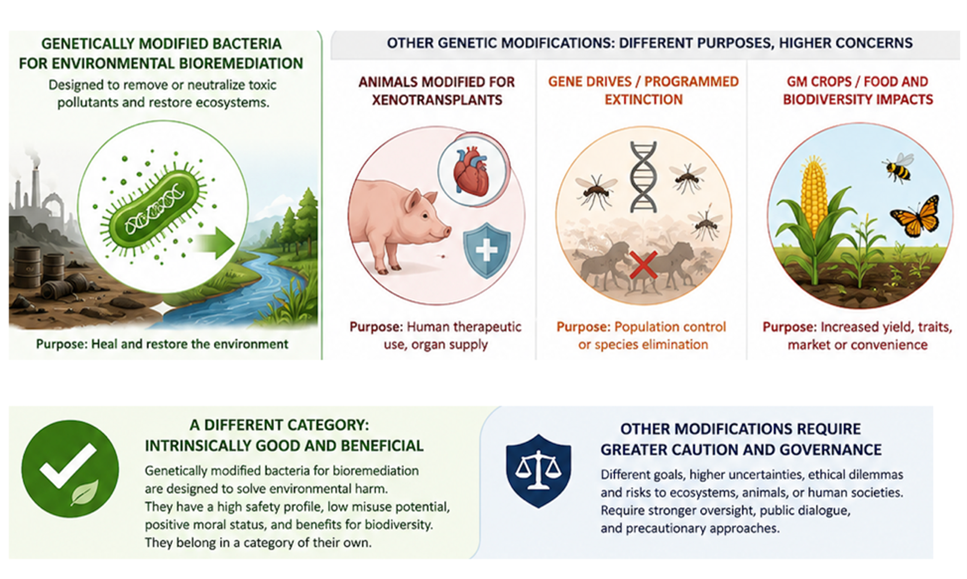
This shift rests on several engineering principles. First, complex systems can often be understood through their constituent parts. Second, standardization enables distributed innovation and decouples design from production and deployment. Third, biological systems can increasingly be approached as programmable entities in which informational instructions (DNA) interact with cellular hardware. Finally, optimization proceeds through iterative Design–Build–Test–Learn cycles rather than purely descriptive experimentation. These conceptual tools have enabled extraordinary advances across medicine, agriculture, industry and environmental restoration. At the same time, they have exposed the limitations of applying conventional engineering principles directly to living systems. Biology remains context-dependent, evolutionary, materially soft, and difficult to standardize fully. Regulatory systems—particularly in Europe—have often responded by emphasizing precaution, containment and restriction. Public perceptions have reinforced this tendency. Genetically modified organisms are frequently perceived as unnatural, dangerous, unpredictable, commercially motivated, or vulnerable to misuse. However, such concerns often treat all genetic interventions as morally and ecologically equivalent, ignoring differences in purpose, scale and context. Environmental applications—such as engineered microorganisms designed for bioremediation—may deserve distinct consideration because their purpose is not extraction or domination but ecological repair.
Addressing this impasse may require more than better technology—it may require different epistemologies. I argue that alternative traditions, including feminist approaches to science and non-Western philosophies offer conceptual resources to rethink synthetic biology-based environmental biotechnology. These perspectives replace the image of isolated organisms acting autonomously with one of relational participation, contextual function and distributed agency. Biological activity emerges not from individuals alone but from interactions among organisms and environments.
The incorporation of feminist and non-Western perspectives into the discussion is not intended as an ethical addendum or as a symbolic gesture to compensate for historical underrepresentation of marginalized actors in science. Nor is it proposed as a rejection of the conceptual foundations of modern biology and engineering. Rather than revealing a failure of existing scientific paradigms, these perspectives highlight dimensions that have historically remained in the background: relationality, contextuality, stewardship, and collective agency. These viewpoints are introduced because they offer conceptual resources to address epistemological limitations that have constrained the full realization of contemporary genetic technologies for collective benefit. Existing frameworks have been extraordinarily successful at identifying and manipulating biological agents, yet they have been less effective at conceptualizing emergence, ecological embeddedness, long-term coexistence, and synergic division of labour.
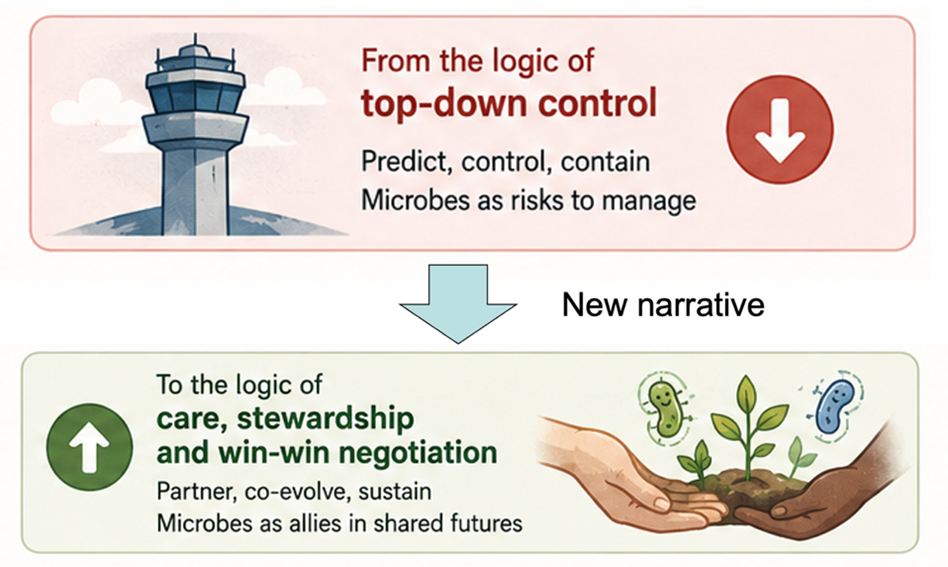
Under this new narrative which we could call Relational Synthetic Biology, the research agenda moves away from the logic of prediction, control and containment toward a framework of care, partnership and co-evolution. Microorganisms are no longer seen exclusively as risks to manage, but as collaborators in shaping healthier and more resilient futures. This transition—from control to stewardship—may ultimately become one of the defining intellectual and societal transformations of twenty-first-century biotechnology.
In this new relational context, Synthetic biology offers a powerful conceptual and technological framework for rebranding the relationship between humans and the living world. Beyond its practical applications, it creates the possibility of moving from passive observation of biological processes to deliberate participation in shaping ecological futures for collective benefit. Yet the realization of this potential remains constrained by two major obstacles. On one hand, there are genuine technical challenges arising from the inherent complexity, contextuality, and unpredictability of living systems. On the other, there is persistent societal unease—and in some contexts outright rejection—towards deliberate intervention in existing genetic heritage and the intentional redesign of life. To date, both the technical and social dimensions of this problem have largely been approached through mindsets centred on containment, risk control, and the anticipation and punishment of dysfunction. While these approaches have contributed important safeguards, they have often reinforced imaginaries of artificiality, danger, and separation between human agency and natural processes, limiting broader technological and societal progress.
Emerging feminist non-Western epistemologies suggest alternative paths beyond this impasse. These perspectives invite a conceptual shift:
- From individual agents to relational emergence: moving attention away from isolated engineered microorganisms toward functions that emerge through interactions within ecological and collective systems.
- From control to care: replacing exclusive reliance on surveillance and containment with approaches based on stewardship, accompaniment, negotiation, and long-term responsibility.
- From intervention to participation: understanding genetic engineering not as an external imposition on nature, but as a form of participation—along with many others—in the ongoing creative dynamics of life and the biosphere, directed toward shared human and ecological flourishing.
Such a reframing may not only improve the technical integration of engineered biological systems into complex environments but also help establish a more socially legitimate and culturally resonant narrative for environmental biotechnology.
The perspectives introduced here should not be understood as an ethical ornament attached to synthetic biology, nor as an attempt to displace the conceptual achievements of modern science. Rather, they are proposed as complementary epistemologies capable of addressing dimensions that current frameworks often leave underexplored: relationality, emergence, ecological embeddedness, and long-term coexistence with living systems. Feminist and non-Western traditions suggest that the future development of genetic technologies may benefit not only from increasing our technical capacity to program live systems, but also from refining how we conceptualize our place within the living world. In this view, progress does not consist in abandoning rational intervention, but in transforming its logic: from agent to relations, from control to care, and from intervention to participation.
At first sight, proposing a transition in Synthetic Biology from control and containment to care and stewardship may sound suspiciously cosmetic: a public-relations exercise intended to make genetically modified organisms appear less threatening, soften public resistance, and ultimately lower regulatory barriers. Such criticism deserves to be taken seriously. Scientific communities have often adopted new vocabularies—responsible innovation, sustainability, participation—without substantially changing how technologies are conceived, developed, or governed. But this is not the claim being made here. The proposal is not that society should suddenly trust genetic engineering because we have found more attractive words to describe it. Nor is it an attempt to bypass legitimate concerns regarding biosafety, ecological uncertainty, corporate concentration, or biosecurity. Those concerns remain real and must remain central. Instead, the argument is that the conceptual framework inherited from the recombinant DNA era has become increasingly incapable of distinguishing fundamentally different classes of interventions and therefore increasingly incapable of governing them intelligently.
The bottomline for a sound discernment on these matters is that we should evaluate biotechnologies not only according to what molecular tools were used, but also according to: [i] What problem is being addressed? [ii] Who benefits and who bears the risks? [iii] What ecological relationships are created or restored? [iv] Can outcomes be monitored, corrected, or reversed? [v] What forms of accountability persist after deployment? [vi] What degree of stewardship accompanies intervention? Seen in this way, care and stewardship are not softer alternatives to responsibility; they are stronger commitments: Containment assumes that safety comes from preventing contact between technology and the world. Stewardship assumes that safety emerges from remaining present after contact occurs. This changes the obligations of all actors. Developers are no longer merely inventors but long-term custodians. Regulators become facilitators of adaptive oversight rather than gatekeepers of static permissions. Citizens become participants in defining acceptable purposes and acceptable risks. End-users become co-designers of technological trajectories instead of passive consumers. And engineered organisms themselves cease to be imagined as isolated artefacts and begin to be understood as participants in ecological networks whose behaviour depends on relationships and context. In that sense, the new narrative proposed here is not a strategy to make GMOs more palatable. It is an invitation to become more discriminating. Not less critical—but more precise. Not to replace regulation with naïve trust—but to replace indiscriminate prohibition with better judgement. And ultimately, not to defend Synthetic Biology at all costs—but to ensure that fear of misuse does not prevent society from responsibly using some of the most powerful tools it has ever developed to repair damaged worlds.
Header Photo: © Krot_Studio – stock.adobe.com