

ANNA TUSCHLING
Three Areas of Digital Complexity
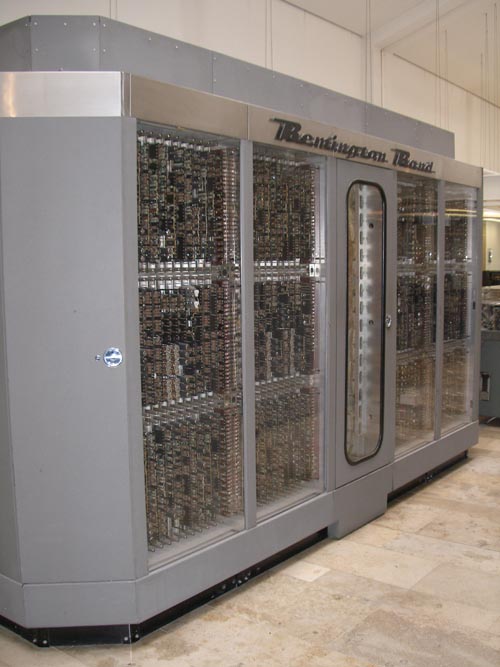
Viewing digital devices in the context of complexity – or even equating the two – seems inevitable given its immense diversification and revolutionary impact over the past eight decades since the development of the first large-scale electronic digital computers at the end of World War II (Computer History Museum 2026). Since 1945, computers have evolved from room-filling behemoths like the Universal Automatic Computer UNIVAC (Figure 1.) into portable everyday items that no longer merely perform scientific and military calculations, but connect us all in complex ways.
Attempts to trace the quite remarkable conceptual history of digital complexity in its concise forms have been rare so far. At least three areas of digital complexity can be distinguished here, each concerning different contexts with their own respective discourses, and which can be traced quite well along the three closely related terms digital technology, digitization, and digitality.
Digital Technology
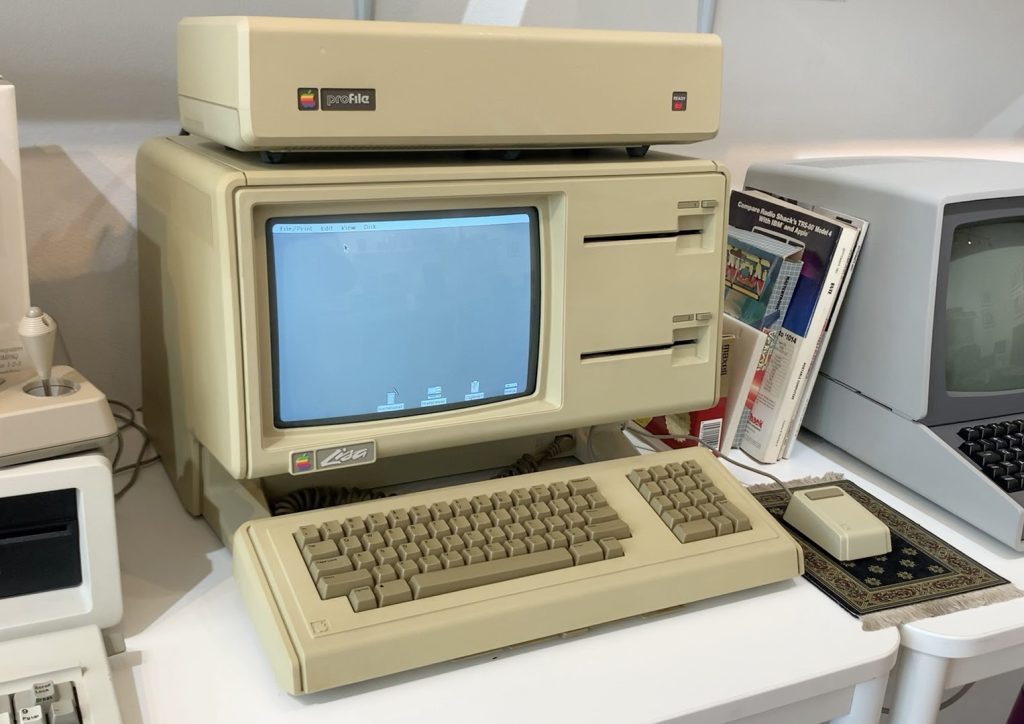
Digital technology is characterized by a complex relationship between the mathematical foundations of computing and their mechanical and electronic implementation, as well as by its fundamental programmability (Davis 1988). Digital complexity affects various levels of technical development, which can be broadly divided into the logical foundations of computing, hardware and software, as well as computer networking. From a historical perspective, the increasing complexity or even “withdrawal of computing” can be linked above all to the development of graphical user interfaces in the 1970s (Figure 2.) (Gaboury 2021), which, even in the experience of informed users, signified a kind of separation into a sensorially tangible “before” and a computational “behind” the screen, as Sherry Turkle documented in her popular work at the Massachusetts Institute of Technology (Turkle 2005, 1997).
However, the perception that digital technology is difficult to comprehend and penetrate often has an additional social component. Digital technology appears complex not only because of how it functions, but also due to economic or political decisions not to make certain parts of the technology – such as the source code of various software applications or chip architectures – public (Krajewski/Dhaliwal 2025).
As a result, digital technology is repeatedly regarded in social debates as inscrutable, opaque, and beyond comprehension. The perception of digital complexity has grown with the resurgence of AI since the beginning of 2020 and, as described, can refer to the functioning of devices and their applications, but also to the strategic withholding of information through the deliberate non-disclosure of socially important data driven by private-sector and national interests. For example, Google’s historical PageRank algorithm and the lack of transparency regarding the training of foundation models by AI companies are much-discussed examples in this context (Offert/Dhaliwal 2024; Burkhardt/Rieder 2024; Rieder 2012).
Digitization
Society repeatedly touts digitalization as a means of modernization, simplifying work, and reducing complexity. However, a review of the literature suggests that we are faced with a kind of chicken-and-egg problem regarding digital complexity: Is the targeted use of computers society’s response to its increasing complexity? Or does digitalization itself lead to increasing complexity, since it constantly demands new updates, staff training, resources of all kinds, and costs, and even creates new problems in the areas of data protection and inequality?
From two classic examples in social and historical research, we can draw the following conclusion: Digital information processing – that is, digitization – manages complexity within organizations and society while simultaneously amplifying it. Sociologist and systems theorist Niklas Luhmann emphasizes the systemic dynamics in automated organizations and societies that lead to increased complexity through digitization(Luhmann 1966). Communication researcher and historian James R. Beniger, on the other hand, highlights the historical dynamics between the increase in management and organizational tasks in modern industrial societies and the rise of information technologyas a tool for controlling them, which is intended to lead to a reduction in complexity.
Luhmann’s point is to link his implicit definition of digital complexity to the fundamental systematic characteristics of computers rather than to their technical complexity or incomprehensibility. Unlike purpose-built tools, digital computers can be used in a wide variety of ways, as we have already experienced many times in our lifetime and will continue to experience with the rise of AI, sensor technology, and new interfaces. Luhmann and his contemporaries already clearly recognize this openness of purpose in computers. The more open-ended and variable digital technology can be used, Luhmann argues, the more it increases the complexity of a system and the stronger the pressure for transformation within a system to adapt to it (ebd.).
Unlike Luhmann, Beniger identified digitalization as a response – if not a reaction – to the problem of control in modern societies characterized by increasing complexity. The fact that modern societies are indeed becoming more complex can be attributed to three dynamics resulting from the increasing division of labor, social change, and growing bureaucracy (Beniger 1989).
Digitality
The third area of digital complexity concerns the conceptualization of digitality in the humanities (Gramelsberger 2023). In order to analyze digital phenomena from a humanities perspective, numerous authors have proposed concepts of digitality in recent years, both in the digital humanities and in philosophy and related disciplines. [1]
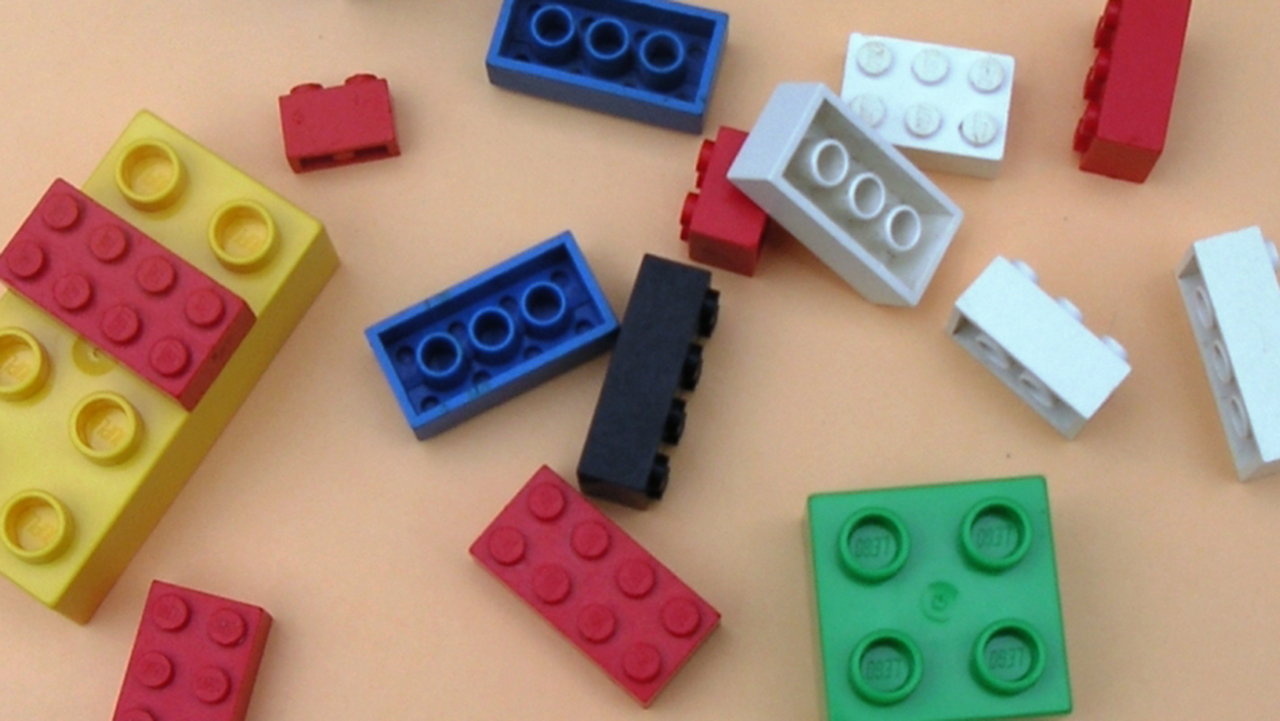
These new terms uncover the complexity of digitality as a medial principle of functioning through its historical depth and multi-layered nature. They attempt to provide a definition of digital information representation that emphasizes its complex properties as systems for transmitting, storing and processing information based on discrete (arbitrary) units (Figure 3.). We are accustomed to viewing binary code – composed of zeros and ones, on which most forms of modern computing are based – as a prime example of a discrete system. But the alphabet, or letters, also embody discreteness in a systematic way.
From the perspective of these concepts of digitality, as philosophers and media researchers as Sybille Krämer, Lydia H. Liu, Alexander Galloway and Beatrice Fazi emphasize, writing systems should, in a certain sense, be regarded as digital systems even before the advent of the modern computer (Krämer 2025; Fazi 2025; Galloway 2014; Liu 2011). The following three functional characteristics of the digital realm can be regarded as the lowest common denominator of the various emerging concepts of digitality (Tuschling 2025):
1. Digitality is discontinuous (discrete) in a process-functional sense
2. Digitality is arbitrary with standardization and modularization
3. Digitality is integrative (systemic, combinatorial)
While digitality thus encompasses broad historical contexts, it does not view itself as an abstraction from the materiality of the various physical computers and other digital systems. Rather, some concepts of digitality draw more heavily on the etymology of the word “digital” and therefore focus specifically on the tactile and haptic dimensions of digitality. The very etymology of the term “digital” – derived from the Latin digitus (meaning “toe” or “finger”) – seems to suggest a concept of digitality that incorporates certain functions and characteristics of the sense of touch or, indeed, of the human hand. Haptic perception, sensing, and touching are modes of experience that are said to have gained in importance in the age of digital media in complex ways.
[1] See the Working Group on the Philosophy of Digitality within the German Society for Philosophy (Deutsche Gesellschaft für Philosophie e.V.), https://www.dgphil.de/arbeitsgemeinschaften/philosophie-der-digitalitaet/; as well as the early series of events: Huber/Krämer/Pias: “Digitality in the Humanities.”

Sources
Beniger, James R. (1989): The Control Revolution: Technological and Economic Origins of the Information Society, Harvard University Press.
Burkhardt, Sarah und Bernhard Rieder (2024): „Foundation models are platform models: Prompting and the political economy of AI“, Big Data & Society 11/2, S. 20539517241247839.
Computer History Museum (2026): „Computer History Timelines“, https://computerhistory.org/timelines/ (zugegriffen am 19.4.2026).
Davis, Martin (1988): „Mathematical Logic and the Origin of Modern Computing“, in: Herken, Rolf (Hrsg.): The Universal Turing Machine. A Half-Century Survey, Hamburg: Kammerer & Unverzagt, S. 149–174.
Fazi, Beatrice M. (2025): „What is digital Theory?“, in: Fazi, Beatrice M. u. a. (Hrsg.): Digital Theory, London-Lüneburg: Univ Of Minnesota Press-meson Press, S. 15–43.
Gaboury, Jacob (2021): Image Objects: An Archaeology of Computer Graphics, Cambridge Massachusetts: The MIT Press.
Galloway, Alexander R. (2014): Laruelle: Against the Digital, Minneapolis: University of Minnesota Press.
Gramelsberger, Gabriele (2023): Philosophie des Digitalen, Hamburg: Junius.
Krajewski, Markus und Ranjodh Singh Dhaliwal (2025): „Quellecodekritik: Wie tief lässt Deep Seek blicken?“, FAZ.NET, 11.07.2025, https://www.faz.net/aktuell/karriere-hochschule/quellecodekritik-wie-tief-laesst-deep-seek-blicken-110579508.html (zugegriffen am 19.4.2026).
Krämer, Sybille (2025): Der Stachel des Digitalen. Geisteswissenschaften und Digital Humanities, Frankfurt New York: Suhrkamp.
Liu, Lydia H. (2011): The Freudian Robot: Digital Media and the Future of the Unconscious, Chicago: University of Chicago Press.
Luhmann, Niklas (1966): Recht und Automation in der öffentlichen Verwaltung, Schriftenreihe der Deutschen Universität für Verwaltungswissenschaften Speyer 29, Berlin: Duncker & Humblot.
Offert, Fabian und Ranjodh Singh Dhaliwal (2024): „The Method of Critical AI Studies, A Propaedeutic“, S. 10.
Rieder, Bernhard (2012): „What is in PageRank? A Historical and Conceptual Investigation of a Recursive Status Index“, Computational Culture 2, http://computationalculture.net/what_is_in_pagerank/ (zugegriffen am 19.4.2026).
Turkle, Sherry (1997): Life on the Screen: Identity in the Age of the Internet, New York: Simon & Schuster.
— (2005): The Second Self, Twentieth Anniversary Edition: Computers and the Human Spirit (Zuerst 1984), Cambridge, Massachusetts: MIT Press.
Tuschling, Anna (2025): „Digitalität“, in: Bedorf, Thomas, Daniel Schubbe und Anna Tuschling (Hrsg.): Grundbegriffe digitaler Kultur, Hagen: Hagen University Press, S. 73–86.
Attributions:
Fig. 1.: Matthias.Kirschner at German Wikipedia, Public domain, via Wikimedia Commons
Fig. 2.: Timothy Colegrove, CC BY-SA 4.0 <https://creativecommons.org/licenses/by-sa/4.0>, via Wikimedia Commons
Fig. 3.: Priwo, LEGO-01, marked as public domain, more details on Wikimedia Commons
One Comment
Comments are closed.