
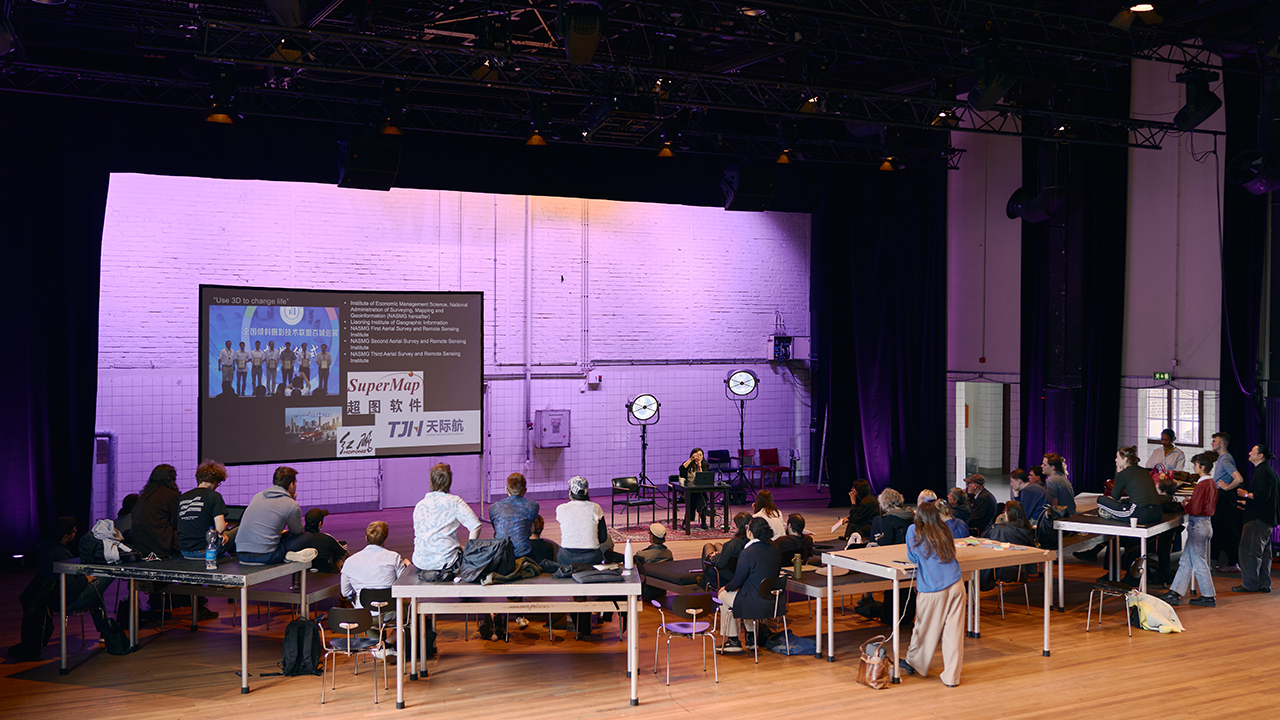
Two days full of conversation about how the future is being made and decided, with and by technologies
ANA MARÍA GUZMÁN OLMOS AND JANA HAMBITZER
Which futures are possible, which are probable, and which are desirable? What kinds of visions of the future are designed and anticipated by scientific practices and technological development? What role do data, algorithms, platforms, and code play in making the future?
These questions stood at the center of the second edition of the event series “Hidden Futures,” which the KHK c:o/re develops and organizes in collaboration with PACT Zollverein, an international center for the performing arts working in the fields of dance, performance, theater, media in Essen.
On May 8 and 9, 2026, a group of KHK c:o/re fellows, students of RWTH Aachen University, artists, and scholars discussed the topic of prediction and promise in relation to the technological futures that are constantly being shaped – by data-driven systems, political programs, and social narratives. In a two-day program consisting of a bus tour into the Rhenish mining area and a series of talks at PACT Zollverein, we explored how visions of the future emerge today. The focus was on the tensions between prognosis and imagination, between technical control and the open space of possibility, as well as between what is made visible and what remains invisible.
Life between coal, abandoned places, and promises
The bus tour through the Rhenish mining area started in Elsdorf at the terra nova viewpoint, where we visited the massive pit of the Hambach open-pit mine. Together with the artist Silke Schatz, we learned about the project of transforming the pit into a new lakeland in the coming years, rich in ecological, economic and tourist potential. The contrast between the reality on the ground, with large machines working, transporting coal to the surface, ecological damage, and displacing former villages and their inhabitants, and the promise of a future local recreation area, whose concrete implementation plans remain unclear, is striking.
Manheim calling walk – the plants in view
With her tour “Manheim calling walk – the plants in view,” Silke Schatz guided us through the abandoned village of Manheim and pointed out the dynamics of changing places like this by highlighting the ruderal vegetation and artworks she created in this context. We reflected on archiving practices, considering how to document ecological destruction and the dynamic processes of a whole village and its citizens. We also contrasted Silke’s archiving practices with the government’s and coal mining companies’ ideas of what will become of Manheim in the future. We witnessed how nature and vegetation conquer back the space, while the history of Manheim is still told and maintained by it.
Starting points and pioneers of change
Empty houses, but also new villagers, were awaiting us in the former open-pit mining village of Bürgewald: Bürgewald was once destined to be displaced for coal mining, but it has remained and become a town challenged by the many different timeframes of its inhabitants. As open space planner Daniela Karow-Kluge explained, some inhabitants have left, some have never left, some have arrived, and some, like a group of refugees, live with the uncertainty of whether they will be allowed to stay. Daniela Karow-Kluge also introduced the project “tu! Hambach,” an annually held platform for dialogue that aims at sustainable structural change through collaborative and transdisciplinary learning. She explained how the event showcases projects, ideas, pioneers, and educational formats that can serve as starting points and spaces for resonance for change.
The bus tour served as a counter-narrative to the industrial exploitation of coal and resources and linked different spaces of knowledge. It became clear that the Rhenish mining region is a contested space that brings up questions about the futures that our present is creating, but also of who has the right to decide over the future, and the future of whom.
Knowledge and practices beyond the promises of technological developments
On the second day of “Hidden Futures,” artists and researchers engaged in a dialogue at PACT to explore different forms of knowledge and practices that go beyond the promises of technological developments. Here, the future was conceived as a present shaped by predictive systems that already organize and produce reality.
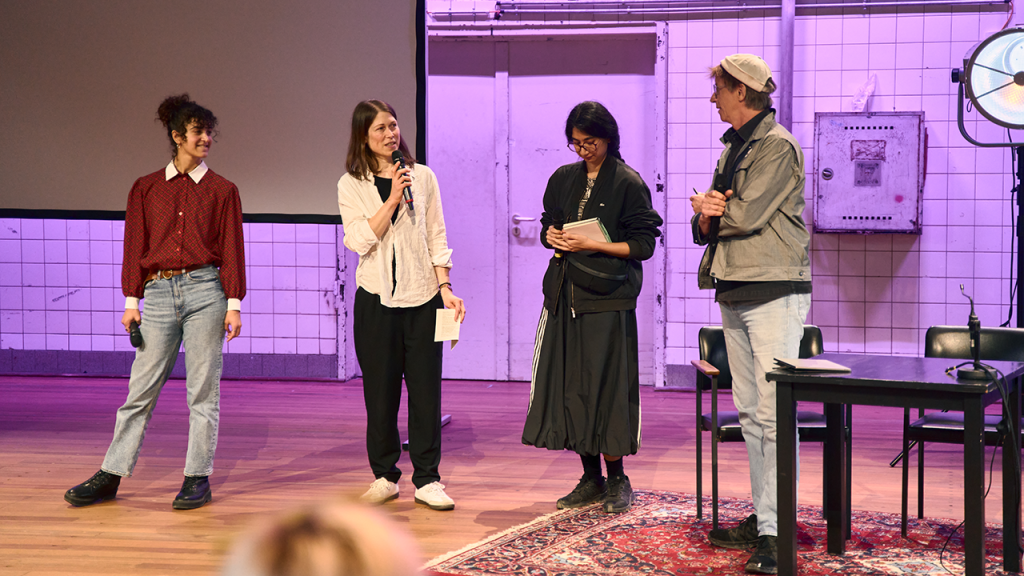
Teamed up in duos, each consisting of an artistic and scientific perspective, the participants discussed phenomena where technology and visions of the future intersect. In four rounds of talks, each followed by a Q&A session, topics such as the idea of legal personhood for Mars, the global flow of goods from China, predictive policing, AI infrastructures, and disability justice technology were explored.
Cosmic Collective – Frictions between human and nonhuman worlds
The first duo, on the topic of “Cosmic Collective – Frictions between human and nonhuman worlds,” consisted of the research-driven art and design collective Nonhuman Nonsense and the philosopher and ethicist Chelsea Haramia.
While Filips Staņislavskis from Nonhuman Nonsense presented their project “Planetary Personhood,” which pursues radical space decolonization and proposes legal personhood for the planet Mars, Chelsea Haramia introduced the conceptional shift and methodological tool of the “Extraterrestrial Turn,” which challenges anthropocentric and Earth-bound frameworks of sustainable technology. The following discussion focused on the relation between humanity and its current and future responsibilities towards the planetary and extraplanetary.
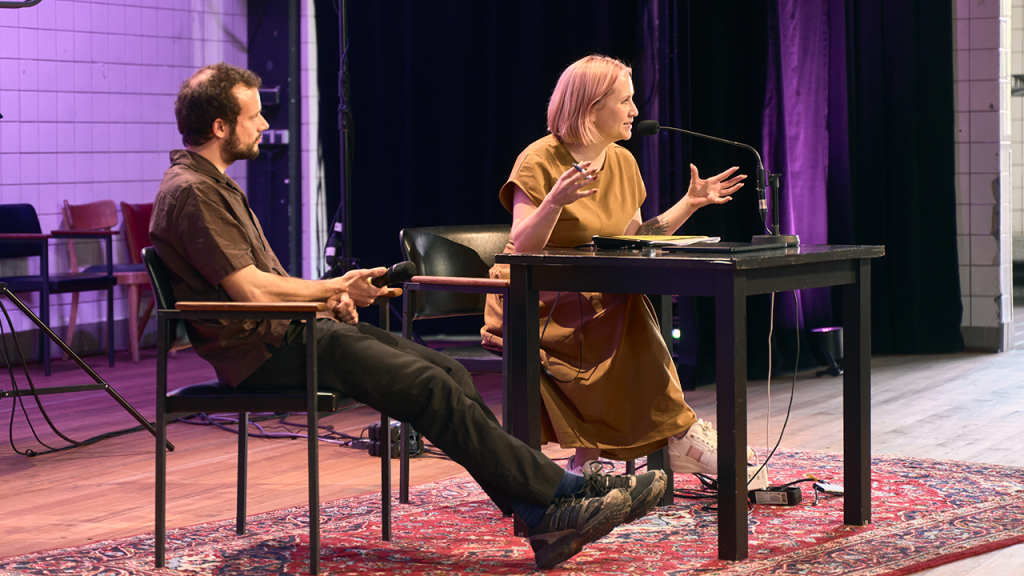
Mapping China – Notes from the Yellow Magic Era & China, rendered
In the second round of talks, “Mapping China – Notes from the Yellow Magic Era & China, rendered,” the artist Choy Ka Fai and the art historian Yi Gu shifted attention to China, questions of the globally of markets, and the projection of ideas of the state in a digital society. Choy Ka Fai’s project “Notes from the Yellow Magic Era” outlines the Chinese influence on the world’s future. Through video snippets and photographs, he pointed out how of Chinese goods flow to the rest of the world and how China’s soft power infiltrates everyday life around the globe. Yi Gu introduced her project on China’s “Real-Scene 3D” initiative as a new infrastructure of territorial governance. Focusing on oblique photogrammetry, it asks how claims to seamless 3D realism depend on expert mediation, hidden labor, and new forms of data-driven land control, especially in rural China.

Shifting Language – The Technological Everyday & Disability Justice
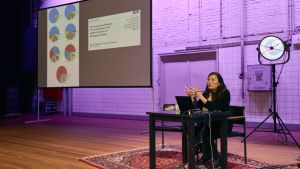
Ren Loren Britton, trans-disciplinary artist-designer, and Nelly Y. Pinkrah, Black and media-studies scholar, partnered up for the topic “Shifting Language –The Technological Everyday & Disability Justice.” Ren Loren Britton presented their work on an index for disability justice tech, which shifts the focus toward questions of agency in the techno social world when a trans*crip perspective becomes the starting point. Their talk was expanded by Nelly Y. Pinkrah’s reflections on language as a historical and epistemic technology, whose recursive operations she traces across speech, sound, and code through Caribbean, Black studies and media theory constellations.


Our Digital Tools – Prison Records & AI War Cloud
The final duo focused on digital tools. The artist and researcher Tomas Percival spoke about his project “Prison Records,” which investigates digital tools used in the prison and probation services in England/Wales and examines how routine administrative tools (databases, risk assessments, and information-sharing protocols) exert significant, often opaque, effects on the lives of incarcerated individuals. Sarah Ciston presented her work “AI War Cloud,” an interactive database and art installation that maps military and commercial dual-use AI systems. She explained the current techno-imperial boomerang effect that is perpetuated by machine learning and asked what users’ responsibilities are when the digital tools they encounter daily are also used to wage war on a global scale.

The Hidden Futures event series is part of c:o/re’s art program, which aims to develop knowledge practices and critical perspectives by bringing together scientific and artistic cultures of research. In Prediction & Promise, we reflected on how technological development materializes visions and ideas of the future, while also bringing about scientific and technological development. Digital societies are the product of political decisions and scientific and technological development. Therefore, it is crucial to engage with critical perspectives that question the narratives surrounding the development of technologies and their purpose. At the event, we explored the various ways in which predictive technologies create temporalities, transform the spaces we inhabit, and shape our bodies. Our goal was to critically engage with our digital present by examining how technology and society affect each other, becoming variables in the social complexity in which we find ourselves.
Photos by Anton Vichrov